Solar Garden Lights That Actually Work: 9 Buying Checks
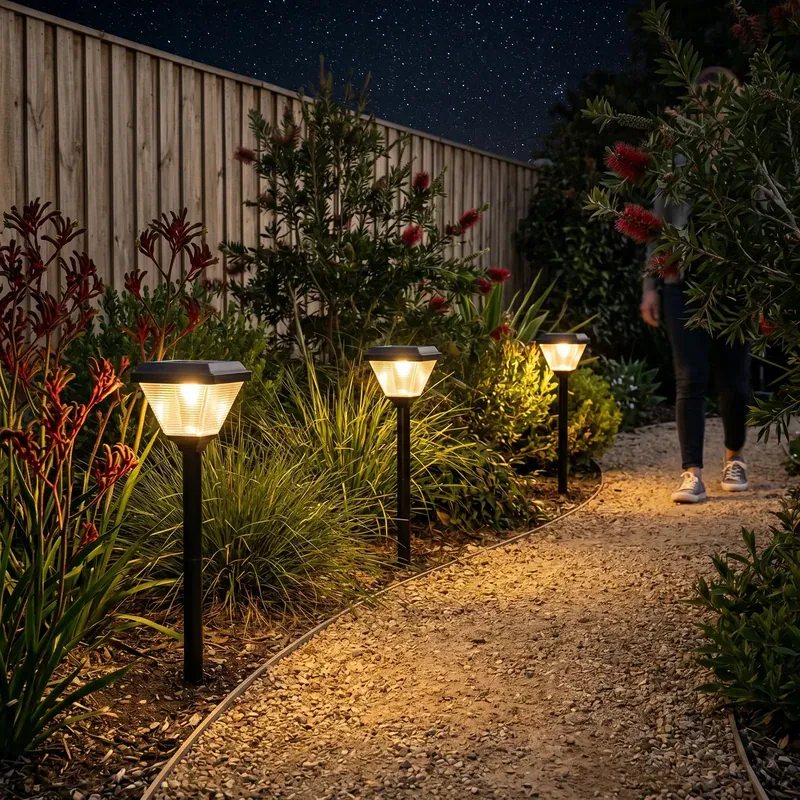
The phrase “solar garden lights that actually work” appears in Google suggestions because buyers have learned that the category varies enormously. Two lights can look almost identical on a listing while using different panel sizes, batteries, seals and control logic. The dependable product is rarely the one with the biggest lumen number or the longest unsupported runtime claim. It is the one whose whole energy system fits the job.
1. Start with the lighting job
A 10-lumen path marker, a 200-lumen tree spotlight and a motion-triggered wall light should not be compared as if they were substitutes. Decide whether the product must mark an edge, create ambience, illuminate a feature or provide short bursts of functional light. Once the job is clear, brightness, beam, operating mode and battery size can be judged together.
2. Read the panel, battery and lumens as one system
The solar panel collects the day’s energy, the rechargeable battery stores it, and the LED spends it after dark. A high-output light paired with a tiny panel and battery cannot sustain its headline brightness for long. Look for all three specifications on the same sheet. If only lumens are shown, the most important part of the performance story is missing.
3. Ask what “runtime” means
Runtime should be tied to a full charge, a lighting mode and a defined output. Some products reduce brightness gradually; others operate at a low level and boost on motion. Both can honestly run for many hours, but they produce different user experiences. A useful specification explains the mode instead of presenting one number without context.
4. Choose brightness that suits the application
More light is not automatically better. Decorative stakes need enough output to show a pattern without flattening the garden. Path lights should guide movement without glare. Spotlights need a beam capable of reaching the intended plant or feature. Overspecifying brightness drains the battery faster and can make a residential garden look harsh.
5. Inspect waterproofing as a design, not a badge
An IP rating is useful, but water resistance also depends on where seams, switches, cable entries and battery doors are located. Ground-level products face splashback and standing water; wall lights face wind-driven rain; string-light control boxes may sit lower than the bulbs. Check the complete assembly and the installation instructions, not only the rating printed in the title.
6. Prefer serviceable batteries
The battery is a normal wear component. A replaceable rechargeable cell can extend the useful life of the fixture and reduce returns that would otherwise require replacing the entire product. Confirm the chemistry, voltage, capacity and access method. A standard-looking battery is not necessarily interchangeable with an alkaline or differently rated rechargeable cell.
7. Look for useful controls
A dusk sensor should prevent daytime operation. A physical off switch can make storage and first charging easier. Motion modes are valuable when a wall light needs occasional high output, while decorative lights benefit from simple, predictable operation. Extra modes only help when the packaging and manual explain them clearly.
8. Judge daylight construction too
Solar garden lights spend more hours visible in daylight than illuminated. Check stake strength, mounting hardware, finish, lens clarity, cable strain relief and the way the panel is angled. A beautiful night image cannot show whether a post twists, a finish looks thin or a bracket makes panel orientation difficult.
9. Test a representative sample
Charge samples in the same outdoor location, record switch-on time and compare brightness later in the night. Repeat after cloudy weather and spray the product according to its intended exposure. For wholesale orders, keep an approved sample and written specification so the production batch can be checked against the same reference.
A quick buyer checklist
- Application and target viewing distance
- Panel type, voltage or rated output
- Battery chemistry, voltage, capacity and replaceability
- LED lumens, color temperature and beam effect
- Runtime tied to a defined lighting mode
- IP rating and vulnerable seams or controls
- Mounting, materials, dimensions and replacement parts
- Pack quantity, manual and after-dark product photography
Bottom line
Solar garden lights that actually work are balanced systems. When the panel, battery, LED load, controls and enclosure all suit the application, the product can deliver a believable amount of light for a believable period. Browse our outdoor solar lights catalog to compare complete model specifications, or use the wholesale inquiry form to request a like-for-like quotation.
Related solar lighting guides
Ready to source solar garden lights?
Send us your target assortment, quantities or OEM brief—our export team will reply with relevant models, specifications and quotation details.
Request a Wholesale Quote Browse Products